
Boundaries questions on the Digital SAT ask you to choose the punctuation that correctly joins or separates the parts of a sentence. College Board lists Boundaries as one of the two skills in the Standard English Conventions domain. Most Boundaries questions come down to one check: is each side of the blank a complete sentence?
The rules fit on one page, and the examples below show each one at work. To drill the skill after you read, use our Digital SAT question banks.
What College Board says Boundaries questions test
The Reading and Writing section has 54 questions split into two 32-minute modules, according to College Board's page on how the SAT is structured. The questions fall into four content domains. One of them, Standard English Conventions, makes up about 26% of the scored questions, or 11 to 15 questions per test, according to Table 14 of the Assessment Framework for the Digital SAT Suite.
College Board's page on the Reading and Writing section says this domain "measures the ability to edit text to conform to core conventions of Standard English sentence structure, usage, and punctuation." It has two skills. The framework describes Boundaries as the skill "for which students must edit text to ensure that sentences are conventionally complete." The other skill, Form, Structure, and Sense, covers usage such as agreement and verb tense. The framework also says Boundaries questions "address such matters as standard end punctuation, semicolon and colon use, and the conventional use (or nonuse) of punctuation, such as commas, dashes, and parentheses, to set off (or not set off) information and ideas within sentences."
Question order matters too. The framework says "Standard English Conventions questions are ordered from easiest to hardest irrespective of skill/knowledge element tested." So Boundaries and Form, Structure, and Sense questions are mixed together. Each time you reach a conventions question, first decide which kind it is. If the four choices differ only in punctuation, it is a Boundaries question.
The six patterns you will see
Want the full lesson? The lesson notes and Targeted Practice are free with a free account.
Start 1-day free trial →College Board splits Boundaries into two parts: between sentences and within sentences. We group the questions into six patterns. The table shows each one with a correct example we wrote.
| Pattern | What sits on each side of the blank | The rule | Correct example |
|---|---|---|---|
| Two complete sentences | A complete sentence on both sides | Use a period, a semicolon, or a comma plus and, but, or, so, for, nor or yet. A comma alone is a comma splice. | The bridge opened in 1932; it still carries trains. |
| Incomplete clause plus sentence | A clause that starts with a word like although, because or when, then a complete sentence | When the incomplete clause comes first, put a comma after it. | Although the storm weakened, the ferry stayed in port. |
| Colon or single dash | A complete sentence, then a list or an explanation | The words before a colon must form a complete sentence. | The crew needed one thing: more time. |
| Extra information | A phrase you could remove without breaking the sentence | Set it off with a matching pair: two commas, two dashes or two parentheses. Never mix them. | The violinist, who trained in Vienna, played the solo. |
| Items in a series | Three or more items | Use commas between items. Use semicolons when the items already contain commas. | The tour stopped in Lima, Peru; Quito, Ecuador; and Santiago, Chile. |
| No punctuation | A subject and its verb, a verb and its object, or information the sentence needs | Leave it alone. Do not split a subject from its verb. | The scientists who mapped the reef found 300 kinds of coral. |
Watch the last row. In one of College Board's own sample questions in the framework, the correct choice adds no punctuation at all. The explanation says the three wrong choices each insert "unnecessary punctuation (a comma, colon, and semicolon, respectively)" between the subject and the verb. If adding a mark would cut the subject off from its verb, the answer is no mark.
How often each pattern shows up in our question bank
College Board does not publish how many questions test each pattern. To get a sense of the mix, we counted the questions in our October 2026 English question bank. Our team tagged 56 of its questions with a Standard English Conventions skill: 30 Boundaries and 26 Form, Structure, and Sense. Here is how the 30 Boundaries questions break down.
| Boundaries pattern (our tag) | Questions in our October 2026 bank |
|---|---|
| Two complete sentences: period or semicolon | 8 |
| Items in a series | 5 |
| Essential or extra information (restrictive vs. nonrestrictive) | 4 |
| No punctuation needed | 3 |
| Extra information set off by paired commas | 3 |
| Colon introducing a list or explanation | 3 |
| Sentence fragment | 2 |
| Incomplete clause plus sentence | 1 |
| Extra information set off by paired dashes | 1 |
| Total | 30 |
These counts come from one bank, so use them as a rough guide. Even so, the two-sentence pattern and the extra-information patterns together account for 16 of the 30 questions. If you master those first, you cover more than half of what we saw.
Three worked examples
These examples are original. Try each one before you read the answer.
Example 1. The town's first public library opened in 1897 ______ its reading room held only forty books.
A) 1897,
B) 1897;
C) 1897
D) 1897, however,
See which question types are costing you points
Start with a free mock, free drills, or preview sample questions before using all 45 question banks.
Answer: B. Cover everything after the blank. "The town's first public library opened in 1897" is a complete sentence. Now cover everything before it. "Its reading room held only forty books" is also complete. Two complete sentences need a period, a semicolon, or a comma plus a word like and. A comma alone (A) is a comma splice. No mark (C) runs the sentences together. "However" between two commas (D) is still a comma splice, because however is not a joining word like and or but.
Example 2. The chemist Alma Ruiz ______ who studied soil bacteria for two decades, published her results in 2019.
A) Ruiz,
B) Ruiz
C) Ruiz, and
D) Ruiz;
Answer: A. The clause "who studied soil bacteria for two decades" is extra information. You could delete it and still have a complete sentence. The comma after "decades" closes the pair, so a comma must open it. B leaves the pair broken. C adds "and," which cannot join a name to a "who" clause. D puts a semicolon after "Ruiz," but the words before it do not form a complete sentence. Notice that there is no comma between "chemist" and "Alma Ruiz." A job title placed right before a name takes no comma.
Example 3. The scientists who mapped the reef ______ found more than 300 kinds of coral.
A) reef,
B) reef;
C) reef:
D) reef
Answer: D. "Who mapped the reef" tells you which scientists the sentence means, so it is essential information and takes no commas. The full subject is "The scientists who mapped the reef," and the verb is "found." Any mark in the blank would split the subject from its verb.
A four-step method for any Boundaries question
- Check the choices. If they differ only in punctuation, treat it as a Boundaries question.
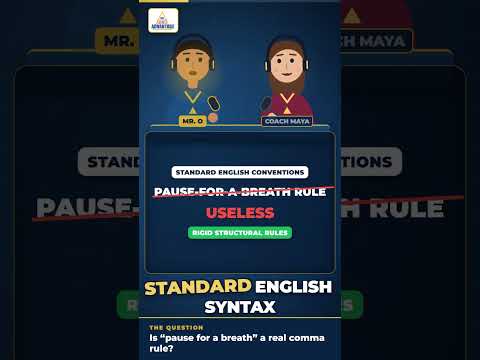
- Read the whole sentence for structure, not for sound. Commas do not go wherever you would pause.
- Test each side of the blank. Ask: could this part stand alone as a sentence?
- Pick the tool that fits. Both sides complete: period, semicolon or comma plus a joining word. One side incomplete: a comma or nothing. Extra information: match the mark that opens or closes it. Subject next to its verb: nothing.
Step 3 matters most. Once you know whether each side is complete, you can rule out most wrong choices. For the full list of rules across both conventions skills, see our SAT grammar rules cheat sheet. For more on each mark, read our guide to commas, semicolons and colons and our look at when a semicolon and a period are interchangeable. Comma questions about opening phrases have their own guide: the comma rule for introductory phrases. To see how many grammar questions a test can include, read how many grammar questions are on the SAT.
Where to practice Boundaries questions
We suggest short sets of one pattern at a time, then mixed sets in the order the test uses. Our free June 2026 Reading and Writing question bank has a full grammar and punctuation section. In our tagging, 14 of its 37 conventions questions are Boundaries questions.
The lesson notes and Targeted Practice below are free, but they need a free account. Create a free account and you can also take one free full-length adaptive practice test, in English or Math, to see how you handle conventions questions under time.
Learn this skill with Mr. O, free
Study the full Boundaries & Punctuation lesson (free) Practice this skill (free)
Question banks: June 2026 Reading and Writing question bank (free) | October 2026 English question bank
Notes and practice need a free account: one click with Google, and you land straight on the lesson.
Sources
- College Board, Assessment Framework for the Digital SAT Suite (Table 14, section 3.5.4 and Table A34)
- College Board, How the SAT Is Structured
- College Board, The SAT Reading and Writing Section
How we built this page (October 23, 2026): the test structure, the domain share and every quoted rule come from the College Board pages above, read on October 23, 2026. The question counts come from our own tags on the October 2026 and June 2026 English question banks, read from our database the same day. The examples were written for this page and are not taken from any test or question bank.
Frequently Asked Questions
What are Boundaries questions on the SAT?
Boundaries questions ask you to pick the punctuation that correctly joins or separates parts of a sentence. College Board lists Boundaries as one of two skills in the Standard English Conventions domain. The other skill is Form, Structure, and Sense.
How many Boundaries questions are on the Digital SAT?
College Board does not give a separate count for Boundaries. It says the Standard English Conventions domain makes up about 26% of scored Reading and Writing questions, or 11 to 15 questions, and Boundaries is one of its two skills.
What is the difference between Boundaries and Form, Structure, and Sense?
Boundaries questions test punctuation between and within sentences. Form, Structure, and Sense questions test usage, such as subject-verb agreement and verb tense. If the answer choices differ only in punctuation, the question is a Boundaries question.
Can a comma join two complete sentences on the SAT?
Only when a joining word such as and, but, or so follows the comma. A comma alone between two complete sentences is a comma splice. Use a period or a semicolon instead.
When is no punctuation the right answer on a Boundaries question?
Choose no punctuation when a mark would split a subject from its verb or a verb from its object, or when the words in question are essential information the sentence needs.
What must come before a colon on the SAT?
A complete sentence. The words before a colon must be able to stand alone. What follows the colon can be a list, an explanation or a second sentence.
How can I practice SAT Boundaries questions for free?
Work through the grammar and punctuation section of our free June 2026 Reading and Writing question bank. Free lesson notes and Targeted Practice need a free account, which also includes one free full-length adaptive practice test in English or Math.