
You're on a roll!
You've completed the free preview of APUSH Free-Response and DBQ Practice (118 Questions). Create a free account to continue this test and access 118 questions across all modules.
Your free account includes
- fa-gauge-highA free adaptive testFull two-module Reading and Writing test with a score estimate.
- fa-magnifying-glass-chartAn in-depth weakness reportThe exact skills that cost you points.
- fa-crosshairsTargeted practiceQuestions picked for your weak skills.
Document A
Source: Elbridge Gerry, letter to the Massachusetts legislature, 1787.
My principal objections to the plan [the Constitution] are, that there is no adequate provision for a representation of the people; that they have no security for the right of election... and that the system is without the security of a bill of rights.
Document B
Source: James Madison, The Federalist paper number 10, 1787.
Among the numerous advantages promised by a well constructed Union, none deserves to be more accurately developed than its tendency to break and control the violence of faction... Extend the sphere, and you take in a greater variety of parties and interests.
Document C
Source: George Washington, letter to the Marquis de Lafayette, 1788.
[The powers] are so distributed among the Legislative, Executive, and Judicial Branches... that it can never be in danger of degenerating into a monarchy... there is no alternative... between the adoption of this and a recurrence to an unqualified state of Anarchy.
Document D
Source: George Mason, Virginia Ratifying Convention, 1788.
The assumption of this power of laying direct taxes does, of itself, entirely change the confederation of the states into one consolidated government. This power... must carry everything before it.
Document E
Source: Alexander Hamilton, “On the Constitutionality of a National Bank,” 1791.
To establish such a right, it remains to show the relation of such an institution to one or more of the specified powers of the government... it is clearly within the provision which authorizes the making of all needful rules and regulations.
Document F
Source: Gazette of the United States (pro-Federalist), 1794.
These [Democratic-Republican] Societies... have been formed... for the sake of preserving liberty. And what is the liberty they are striving to introduce? It is the liberty of reviling the rulers... and persuading people to resist [laws].
Document G
Source: General Advertiser (anti-Federalist), 1794.
As violent means appear [to be] the desire of high toned government men, it is to be hoped that those who derive the most benefit from our revenue laws will be the [first] to march against the Western insurgents.
Document H
Source: Edward Livingston, addressing Congress on the Alien Act, 1798.
By [the Alien Act] the President alone is empowered to make the law... This comes completely within the definition of despotism—a union of legislative, executive, and judicial powers.
Document I
Source: United States Supreme Court, Marbury v. Madison, 1803.
It is emphatically the province and duty of the judicial department to say what the law is... The judicial power of the United States is extended to all cases arising under the Constitution.
Document J
Source: Map showing the United States in 1804, including the Louisiana Purchase and various territories.
Provide a thesis statement that identifies the primary controversies during ratification and explains how they persisted into the early 19th century.
Document 1
Source: John Dickinson, Letters from a Farmer in Pennsylvania, 1767.
Never did the British parliament [before] . . . think of imposing duties in America; FOR THE PURPOSE OF RAISING A REVENUE. . . . If [Parliament] ONCE admit, that Great-Britain may lay duties... for the purpose of levying money on us only... we are as abject slaves.
Document 2
Source: Report of a non-consumption agreement by women in Boston, 1770.
...we think it our Duty perfectly to concur with the true Friends of Liberty... in their Resolutions, totally to abstain from the Use of TEA. . . . This Agreement we cheerfully come into, as we believe the very distressed Situation of our Country requires it.
Document 3
Source: Petition on behalf of Belinda Sutton to the Massachusetts legislature, 1783.
[For] Fifty years [Belinda’s] faithful hands have been compelled to ignoble servitude... By the laws of the land, [Belinda] is denied the enjoyment of one morsel of that immense wealth... accumulated by her own industry.
Document 4
Source: George Washington, letter to James Madison on Shays’ Rebellion, 1786.
We are fast verging to anarchy and confusion! . . . What stronger evidence can be given of the want of energy in our governments than these disorders?
Document 5
Source: Benjamin Rush, Thoughts Upon Female Education, 1787.
...it is necessary that our ladies should be qualified... to concur in instructing their sons in the principles of liberty and government. . . . it is high time . . . to adopt manners in every thing, that shall be accommodated . . . to the forms of our government.
Document 6
Source: An Address to the People of the State of New-York (Anti-Federalist pamphlet), 1788.
The idea of receiving a form [of government] radically defective, under the notion of making the necessary amendment [later], is evidently absurd.
Document 7
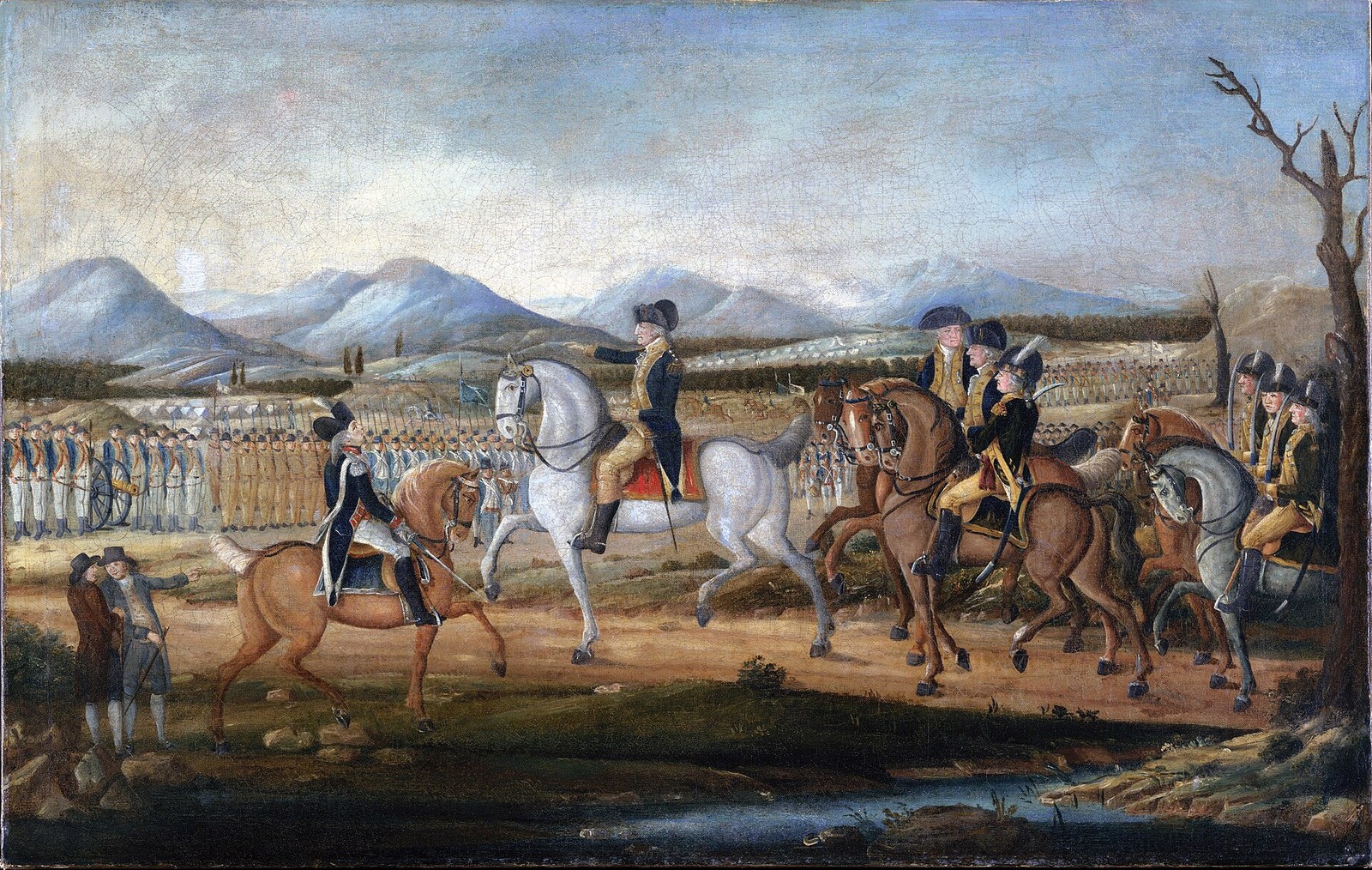
Source: Painting by Frederick Kemmelmeyer depicting George Washington reviewing troops sent to suppress the Whiskey Rebellion in 1794.
Construct a historically defensible thesis evaluating the extent to which the American Revolution changed United States society between 1765 and 1800.
Document 1
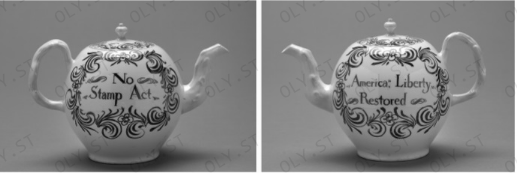
Source: Inscribed Teapot, England, 1766–1770.
Inscribed on one side with “No Stamp Act” and on the other with “America, Liberty Restored.”
Document 2
Source: The Virginia House of Burgesses, The Virginia Resolves, 1769.
...the sole Right of imposing Taxes... is now, and ever hath been, legally and constitutionally vested in the House of Burgesses. . . . [We assure the King] of our inviolable Attachment to his sacred Person and Government.
Document 3
Source: Samuel Adams, The Rights of the Colonists, 1772.
When men enter into society, it is by voluntary consent. . . . The natural liberty of man is to be free from any superior power on earth, and not to be under the will or legislative authority of man, but only to have the law of nature for his rule.
Document 4
Source: Quaker leaders, address to the Pennsylvania assembly, 1775.
...we publicly declare against every usurpation of power and authority in opposition to the laws and government, and against all combinations, insurrections, conspiracies, and illegal assemblies... we hope . . . to maintain . . . the fidelity we owe to the King.
Document 5
Source: Janet Schaw, Journal of a Lady of Quality, 1775.
The alternative is proposed. Agree to join us [the Patriots] and your persons and properties are safe . . . if you refuse, we are directly to cut up your corn, shoot your pigs, burn your houses... this method has seldom failed with the lower sort.
Document 6
Source: Charles Inglis, The Costs of Revolution, 1776.
Where the money is to come from... I know not. . . . our commerce and agriculture... will not support such an expense. . . . what then must our situation be... when every article of commerce... must be heavily taxed to defray that expense!
Document 7
Source: Thomas Paine, The American Crisis, 1776.
These are the times that try men’s souls. . . . Tyranny, like hell, is not easily conquered. . . . Britain, with an army to enforce her tyranny, has declared that she has a right (not only to tax) but “to bind us in all cases whatsoever.”
Construct a thesis statement evaluating the extent of change in ideas about American independence from 1763 to 1783.