
You're on a roll!
You've completed the free preview of AP U.S. History MCQ Question Bank. Create a free account to continue this test and access 1648 questions across all modules.
Your free account includes
- fa-gauge-highA free adaptive testFull two-module Reading and Writing test with a score estimate.
- fa-magnifying-glass-chartAn in-depth weakness reportThe exact skills that cost you points.
- fa-crosshairsTargeted practiceQuestions picked for your weak skills.
Select the best answer for each of the following questions.
Before 1492, many American Indian cultures were strongly influenced by the
An outline map of North America titled “American Indian Population Density in 1500” is shown. Alaska, Canada, few parts of the United States of America, major parts of Quebec, and Greenland are marked with lowest population density. The northern and western boundaries of Alaska, British Columbia, major parts of the United States of America, parts of Mexico, and Newfoundland are more densely populated than the previous. The parts of British Columbia that lie along the coastline of the Gulf of Alaska, major parts of the United States of America, especially in the central and north-eastern parts of the country, and few parts of southern Greenland are marked as more densely populated than the previous. A very few parts of Alaska and Canada that lies along the coastline of the Bering Sea and the Gulf of Alaska, the boundaries of Nevada, Montana, Ohio, Alabama, and Mississippi in the United States, and Honduras are marked as regions with dense population. The western boundaries of Canada and the western and the eastern boundaries of the United States of America are more densely populated. A very few parts of Denver, major parts of Mexico, Guatemala, Belize, El Salvador, Nicaragua, Costa Rica, Panama, Cuba, Havana, Jamaica, Haiti, Bahamas, Puerto Rico, and Dominican Republic are marked as the regions with the highest population density.
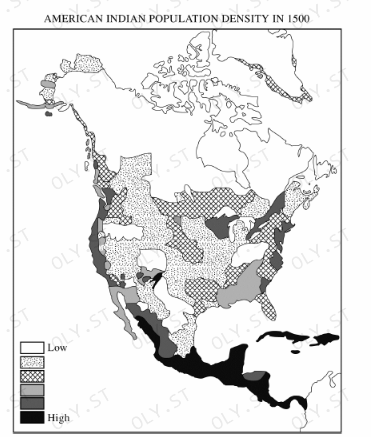
Which of the following statements about the population of North America at the time of Christopher Columbus’ voyages is supported by the map above?
“You have told us that we do not know the One who gives us life and being, who is Lord of the heavens and of the earth. You also say that those we worship are not gods. This way of speaking is entirely new to us, and very scandalous. We are frightened by this way of speaking because our forebears who engendered and governed us never said anything like this. . . .
“It would be a fickle, foolish thing for us to destroy the most ancient laws and customs left by the first inhabitants of this land. . . . All of us together feel that it is enough to have lost, enough that the power and royal jurisdiction have been taken from us. As for our gods, we will die before giving up serving and worshiping them. This is our determination; do what you will.”
Lords and holy men of Tenochtitlan [the Aztec capital], reply to the Franciscans in 1524 after the conquest of Mexico, from a Spanish account written in 1564
The ideas expressed in the excerpt most directly resulted from which of the following?
“The development of a plantation economy, beginning in the sixteenth century, transformed Africa, America, Europe, and Asia, too. It displaced the old silk trade and shifted the increasingly dynamic center of the world economy westward to the Atlantic. . . .
“The Atlantic economy supplied eager European consumers with mildly addictive . . . crops like tobacco and coffee, along with sugar. . . . The Atlantic plantation system transformed these three [products] into items of general consumption. . . . Investors prospered, and capital for further economic development accumulated in the [home country]. The governments found funding and motive to develop sea power. The Americas had lucrative export crops and developed a society based on a system of labor exploitation of Africans, and Africa suffered the transport of eleven million of its people to the New World.”
Thomas Bender, historian, A Nation Among Nations: America’s Place in World History, 2006
The second paragraph of the excerpt makes which of the following claims about the introduction to Europe of new crops from the Americas?
“I said everything to them I could to divert them from their idolatries, and draw them to a knowledge of God our Lord. Moctezuma replied, the others assenting to what he said, that they had already informed me they were not the aborigines of the country, but that their ancestors had emigrated to it many years ago; and they fully believed that after so long an absence from their native land, they might have fallen into some errors; that I having more recently arrived must know better than themselves what they ought to believe; and that if I would instruct them in these matters, and make them understand the true faith, they would follow my directions, as being for the best. Afterwards, Moctezuma and many of the principal citizens remained with me until I had removed the idols, purified the chapels, and placed the images in them, manifesting apparent pleasure.”
Letter from Hernán Cortés to Charles V, Holy Roman Emperor and King of Spain, on his interaction with the Mexica (Aztecs), 1520
Moctezuma’s statement that the Mexica “were not the aborigines of the country” most likely refers to which of the following developments?